Nuggets Match Thunder Offer Sheet, Keep Spencer Jones
By Edwin V. Christopher
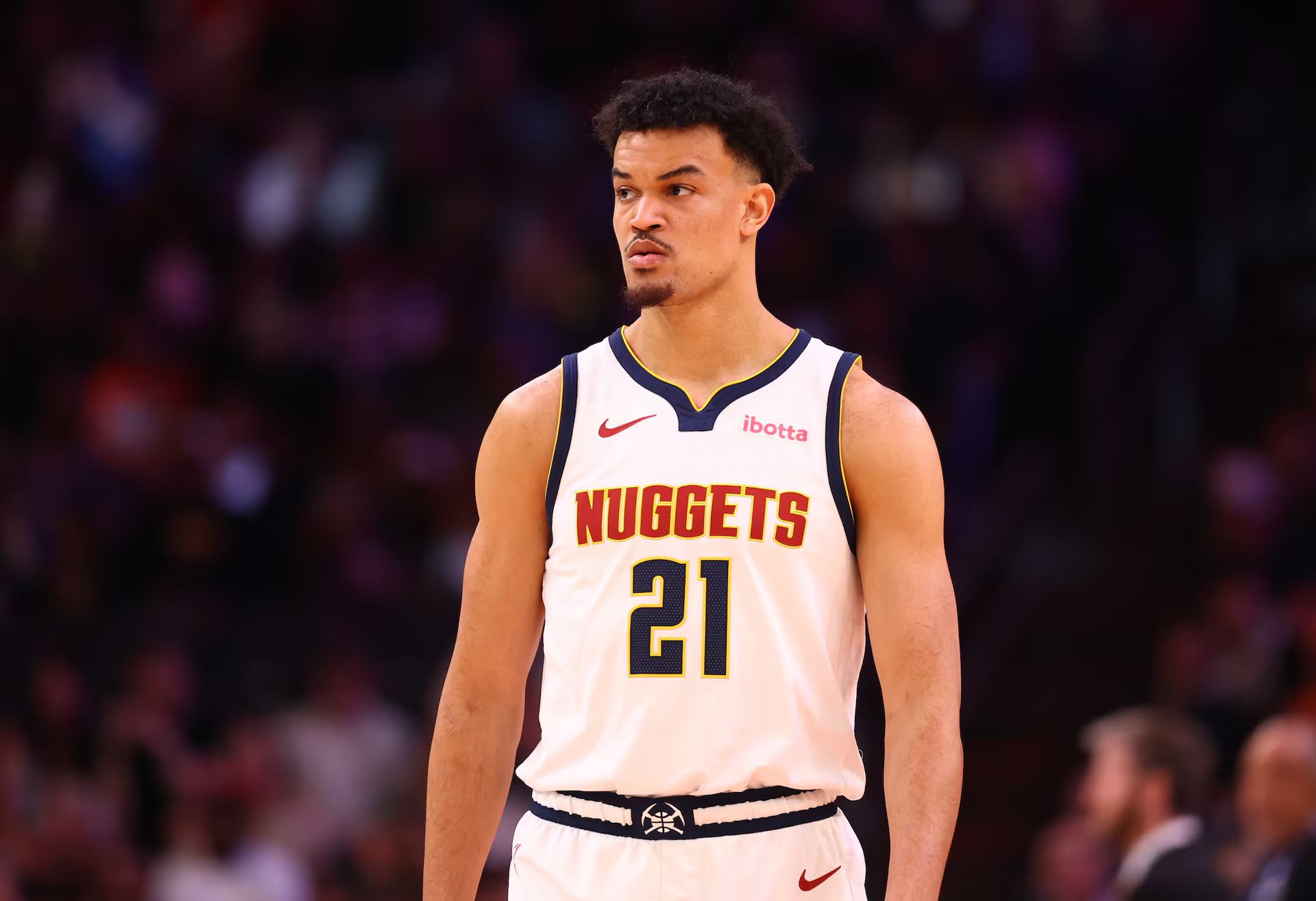
DENVER — The Denver Nuggets are keeping Spencer Jones after all. Team officials confirmed Sunday night that they matched a fully guaranteed, two-year offer sheet worth $12 million that the Oklahoma City Thunder had put in front of the restricted free agent forward just two days earlier, closing the door on what briefly looked like a real chance the Thunder could pry away one of Denver's most reliable role players. The decision did not come cheap. By retaining Jones, the Nuggets pushed their projected luxury tax bill from roughly $36 million to nearly $69 million and crossed into the NBA's second apron for the first time under the league's current collective bargaining agreement, a threshold that carries real roster restrictions along with the added expense. Denver is now the only team in the league sitting above that line, a fact that says as much about the front office's priorities this summer as it does about Jones himself. Front office watchers had spent the weekend debating whether a team long known for guarding its wallet would actually pull the trigger. Jones is not a star. He is not even, by scoring average, a starter on paper. But two seasons into his career, he has become the kind of player contenders quietly depend on — someone who defends, moves the ball and, most importantly for a Denver team built around Nikola Jokic's passing, makes shots when left open. That last part is what made the offer sheet dangerous for Denver in the first place. Jones shot better than 39 percent from three-point range on decent volume during the regular season and was even sharper once the games mattered most, leading all postseason players in three-point accuracy at just over 69 percent. For a franchise that has learned the hard way how much floor spacing matters around its two-time MVP center, losing that kind of shooting for nothing would have stung. Jones' path to this point has been anything but conventional. He went undrafted out of Stanford in 2024 after five college seasons, signed a modest two-way contract with Denver and barely cracked the rotation as a rookie, logging just over 100 minutes across 20 appearances. The Nuggets brought him back on another two-way deal the following offseason, and when injuries — most notably to forward Aaron Gordon — opened up minutes, Jones seized them. He was converted to a standard NBA contract in February and finished the season averaging 5.5 points and 3.3 rebounds while starting 37 of his 64 appearances. The Thunder, fresh off trading wing Luguentz Dort to Atlanta and sitting comfortably below the second apron themselves, saw an opportunity to add a low-cost, high-value piece using their taxpayer mid-level exception. Oklahoma City general manager Sam Presti has built a reputation for identifying exactly these kinds of undervalued contributors, and Jones fit the profile. With the offer sheet unsuccessful, that exception now reverts back to the Thunder to use elsewhere. For Denver, the calculus came down to a simple question: is a meaningfully better roster worth the extra tax penalty? The Nuggets answered yes, at least for now. They still have work to do. Forward Peyton Watson remains a restricted free agent with the Atlanta Hawks, Milwaukee Bucks and LA Clippers all said to be interested, and if he signs an offer sheet elsewhere, Denver will face the same expensive decision all over again. The front office has already lost swingman Tim Hardaway Jr. to Miami this offseason, even as it brought back guard Tyus Jones and added forward Marvin Bagley III on a one-year deal. Because Denver used Jones' Early Bird rights to complete the match, he will carry the right to veto any trade during the 2026-27 season, a detail that could matter if the Nuggets look to shed salary elsewhere to soften the tax hit. Since the league's modern luxury tax system began in 2002-03, Denver has paid roughly $53 million in penalties total, a number that could climb sharply once this season's bill comes due. Reaction around the league Sunday night reflected just how unusual the move was for a franchise that has typically avoided the tax whenever possible. Denver's front office has preached financial discipline for years, even as the roster around Jokic remained one of the league's most talented. Choosing to absorb an eight-figure tax hit for a rotation piece rather than a marquee name marks a shift in approach, one that suggests ownership is willing to pay a premium to protect the depth that helped carry the Nuggets deep into last season's playoffs. None of that changes the outlook heading into training camp. Jones is back in a Nuggets uniform, back in the rotation and, if last season is any indication, ready to keep knocking down open threes alongside Jokic, Jamal Murray and the rest of a roster still built to contend. Whether the front office can now navigate its tax situation without further weakening the roster around him is the next question — and, with Watson's future still unresolved, likely not the last expensive one Denver will face this summer.