Quantum Computer Beats Classical Limit in New Test
By Edwin V. Christopher
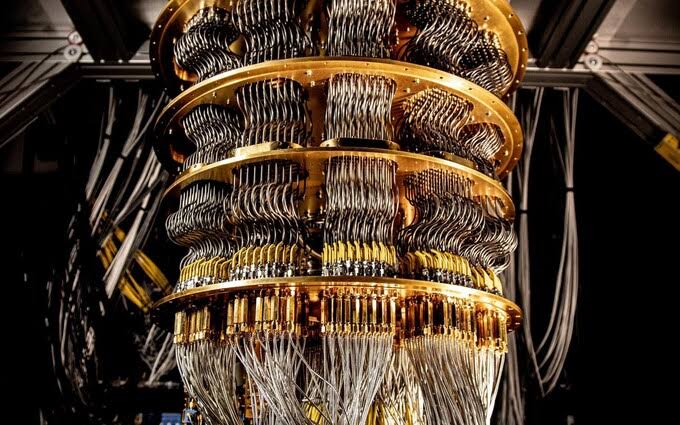
A team of physicists has demonstrated that a quantum computer can decisively outperform every possible classical computer on a specially designed task, offering one of the clearest and most rigorously verified proofs yet of genuine quantum advantage. The experiment, led by computer scientists Marcello Benedetti and Harry Buhrman at Quantinuum in the United Kingdom, was carried out on the company's H2 trapped-ion quantum processor and published in the journal Nature Communications. The breakthrough tackles a long-standing obstacle in quantum computing known as the verification problem. Quantum machines are theorized to solve certain problems far faster than ordinary computers, but confirming that a quantum system has actually done so is notoriously hard, since checking the answer can itself demand computing power that no classical machine realistically has. Until now, many claims of quantum superiority have rested on assumptions about what classical hardware could never achieve, rather than airtight mathematical proof. To close that gap, the researchers built a game around a task called complement sampling. In the setup, a large pool of possible answers is split evenly into two groups, labeled A and B. A system is handed one answer known to belong to group A and must then produce an answer from group B. A classical computer, limited to reading one definite piece of information at a time, has almost nothing to work with beyond knowing which single answer to avoid, and its odds of success collapse as the pool of possible answers grows. The team was able to calculate, with mathematical certainty, exactly how well the best-case classical strategy could ever perform, independent of any assumption about computing difficulty. A quantum computer, by contrast, exploits superposition, the ability of a qubit to hold multiple states simultaneously rather than settling on a single 1 or 0 until measured. Instead of collapsing to one sample from group A, the quantum system can receive and hold the entire set in superposition. Using what the team calls a swapper circuit, it transforms that superposed state into one representing the complementary group B before ever taking a measurement. In principle, a flawless quantum system wins the game every single time, a feat no classical strategy can match once the answer pool grows large enough. When the researchers ran the test on real hardware, scaling their trials up to 55 qubits and repeating thousands of circuits, the machine was not perfect. Added quantum operations introduced hardware noise that chipped away at performance as the problems grew larger. Even so, the quantum processor cleared the mathematically proven classical ceiling in every single trial, producing results that were statistically incompatible with any classical approach, however clever. Crucially, as the difficulty of the task increased, so did the margin of victory. The gap between quantum and classical performance widened exponentially with the length of the bit strings involved, tracking closely with theoretical expectations even if it fell short of the mathematical ideal. At the largest scale tested, using 37-bit strings, the team reported what they described as an exponentially large violation of what classical computing can achieve. The experiment carries a notable technical caveat. Both roles in the game, the referee that selects the starting answer and the player that returns the complementary answer, were run on the same quantum machine, with quantum teleportation used to simulate the communication link between them rather than an actual separate channel. Researchers say a more stringent version of the test would connect two independent quantum computers, a step they expect to pursue in future work. Despite that limitation, scientists not involved in shading the results say the approach marks a meaningful advance because it sidesteps the assumptions that have complicated earlier quantum advantage claims. The test's outcomes are simple to verify, its classical performance ceiling is proven rather than estimated, and it scales cleanly as problems get harder, qualities that have proven difficult to combine in a single experiment. The Quantinuum team notes that their method isolates the power of quantum superposition itself, without relying on more complex phenomena such as entanglement or nonlocal correlations to produce the advantage. The finding adds to a fast-moving string of recent announcements in the quantum computing field, following separate reports this year of quantum systems completing verified computations and simulating complex particle interactions beyond the practical reach of classical supercomputers. Taken together, researchers say these results suggest the field is steadily accumulating a body of evidence, rather than a single headline claim, that quantum hardware can outperform classical machines on well-defined, independently checkable tasks. Analysts tracking the technology's development say tests like this one could eventually serve as standardized benchmarks for comparing rival quantum hardware platforms as the technology matures toward practical, real-world applications beyond the research lab.