Newly Discovered Asteroid 2026 JH2 Passes Dangerously Close to Earth
By Edwin V. Christopher
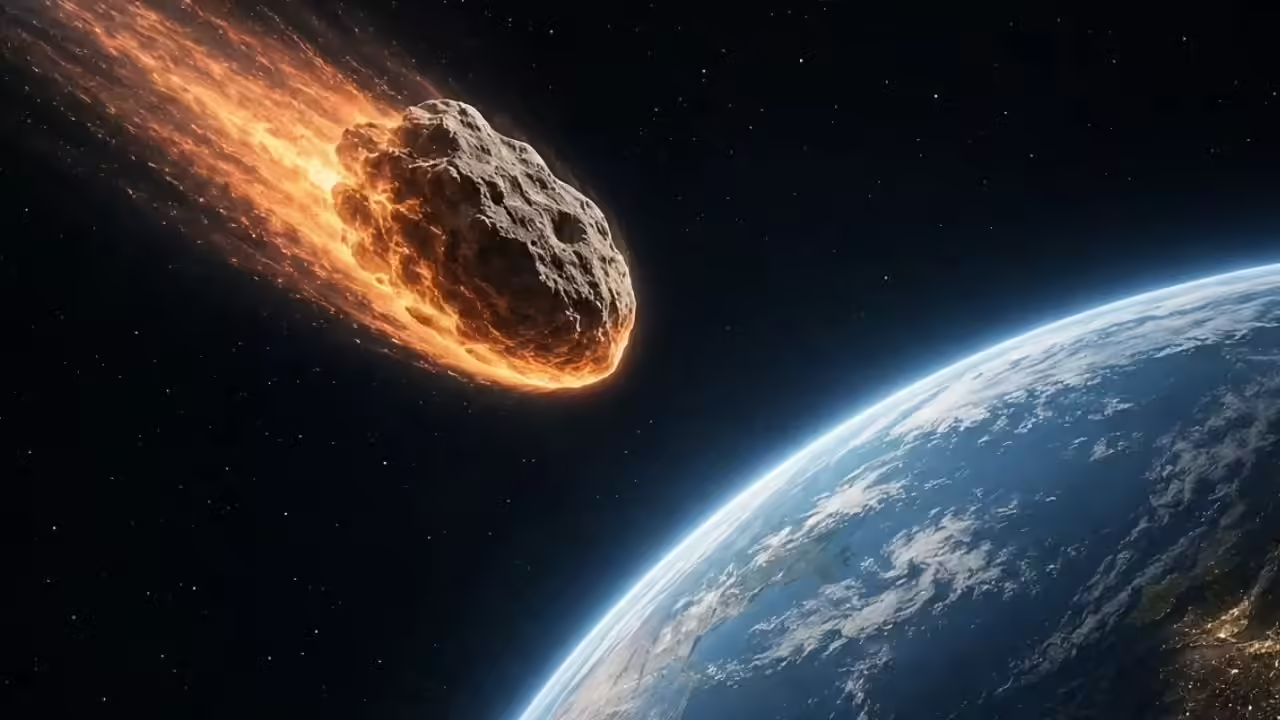
Astronomers closely monitored a newly discovered asteroid known as 2026 JH2 after it passed shockingly close to Earth, raising concerns about how little warning scientists had before detecting the object. The asteroid, described by some experts as a potential “city-killer,” passed within roughly 56,000 miles of Earth, a distance significantly closer than the Moon’s orbit. Scientists said the asteroid was only discovered days before its closest approach, highlighting major ongoing challenges in detecting smaller near-Earth objects moving rapidly through space. Researchers estimated the object measured somewhere between 50 and 115 feet wide, roughly comparable in size to a school bus, blue whale, or small building depending on the estimate used. While NASA and astronomers confirmed the asteroid posed no collision threat during this flyby, experts warned that an impact from an object of this size could still devastate a major city if its trajectory were different. Astrophysicist Mark Norris told New Scientist that “in astronomical terms, it’s as close as you can get without hitting.” The asteroid traveled at speeds estimated near 20,000 miles per hour as it crossed Earth’s neighborhood. Because it approached from a difficult viewing angle and was relatively small, astronomers said detecting it earlier proved extremely challenging. The flyby immediately attracted global attention because it became one of the closest known asteroid approaches of the year. Researchers said the incident serves as another reminder that many potentially hazardous near-Earth objects remain difficult to detect until shortly before passing Earth. Scientists Warn Detection Systems Still Have Major Blind Spots The close approach of asteroid 2026 JH2 renewed concerns among astronomers and planetary-defense researchers about weaknesses in global asteroid detection systems. Scientists emphasized that smaller near-Earth objects can remain hidden until just days before a close flyby because of their size, speed, and approach direction. Many asteroids approach Earth from the region near the Sun, which is very difficult for ground-based telescopes to observe, scientists said. Smaller objects also reflect very little sunlight, further complicating detection efforts until they move relatively close to Earth. Although 2026 JH2 was not large enough to cause global devastation, experts noted it could still produce severe regional destruction if it struck a populated area. Scientists frequently classify objects of this size as “city-killers” because an impact could flatten buildings, create powerful shockwaves, and injure or kill large numbers of people. Astronomers stressed that close flybys themselves are not especially rare. According to reports, more than 70 asteroids are expected to pass within lunar distance of Earth during 2026 alone. However, many are only discovered shortly before arrival, leaving little time for preparation if one were actually on a collision course. The incident also reignited discussions about the importance of planetary-defense programs. NASA’s DART mission, which successfully changed the orbit of an asteroid during a 2022 test mission, was cited repeatedly as evidence that asteroid deflection technologies could work if there’s enough warning time. Scientists said better monitoring systems, more space telescopes and broader international cooperation are still key to spotting hazardous asteroids sooner and enhancing humankind’s ability to respond to future threats. Astronomers and Skywatchers Closely Track Rare Flyby The unusually close approach of 2026 JH2 generated intense interest among astronomers, amateur skywatchers, and online viewers worldwide. Although the asteroid could not be seen with the naked eye, scientists said observers using backyard telescopes and high-powered binoculars had opportunities to track the object during its closest approach. The asteroid reached its closest point to Earth on May 18 at approximately 21:23 UTC. At that moment, it passed at a distance roughly one-quarter of the distance between Earth and the Moon. Astronomers described the flyby as exceptionally close in astronomical terms. The Virtual Telescope Project in Italy organized a livestream event so people worldwide could watch the asteroid move across the night sky in real time. Scientists noted that European observers had better viewing conditions because the flyby occurred during daylight hours across much of the United States. Researchers also used the event to collect additional observational data about the asteroid’s orbit, composition, and brightness. Scientists believe 2026 JH2 likely follows an elliptical orbit around the Sun that takes approximately 3.7 years to complete. The asteroid has been designated a near-Earth object, or NEO, which are carefully tracked because their orbits cross or come very close to that of Earth. Astronomers around the world routinely track thousands of such objects using observatories, radar systems and space-based monitoring programs. Despite the dramatic headlines surrounding the flyby, scientists stressed there was never any realistic impact danger from 2026 JH2 in this encounter. Still, many scientists argued the event provided a valuable real-world example of why asteroid monitoring remains a critical area of global scientific and security planning. Planetary Defense Efforts Gain Renewed Attention After Flyby The close passage of asteroid 2026 JH2 renewed public attention on planetary-defense strategies and humanity’s ability to respond to future asteroid threats. Experts said the incident demonstrated both the progress and limitations of current asteroid-detection systems. NASA and international space agencies have increasingly prioritized planetary defense during the past decade as astronomers discovered more near-Earth objects capable of causing regional or global damage. This year one of the biggest milestones was the successful DART mission by NASA, which purposely crashed a spacecraft into the asteroid Dimorphos and successfully changed its orbit. Scientists explained that deflection missions like DART would only work if dangerous asteroids are discovered with sufficient warning time. The late discovery of 2026 JH2 therefore raised concerns about how many small but dangerous objects could still evade detection until very late stages. Researchers also compared the flyby to other famous asteroid threats, including Apophis, which will pass extremely close to Earth in 2029, and asteroid 2024 YR4, another object discussed in planetary-defense monitoring programs. Experts noted that while extremely large asteroid impacts are rare, smaller regional-impact events occur more frequently throughout Earth’s history. The 2013 Chelyabinsk meteor explosion over Russia injured more than 1,000 people despite involving an object far smaller than many globally catastrophic asteroids. Scientists therefore argued that continued investment in asteroid surveys, space telescopes, and international coordination remains essential. Many experts agree that detection systems will need to improve dramatically in the future if humanity is to have any hope of reliably identifying hazardous objects early enough to take meaningful defensive action.