Pentagon Uses Puerto Rico as the Caribbean Military Hub
By Roy J. Miles
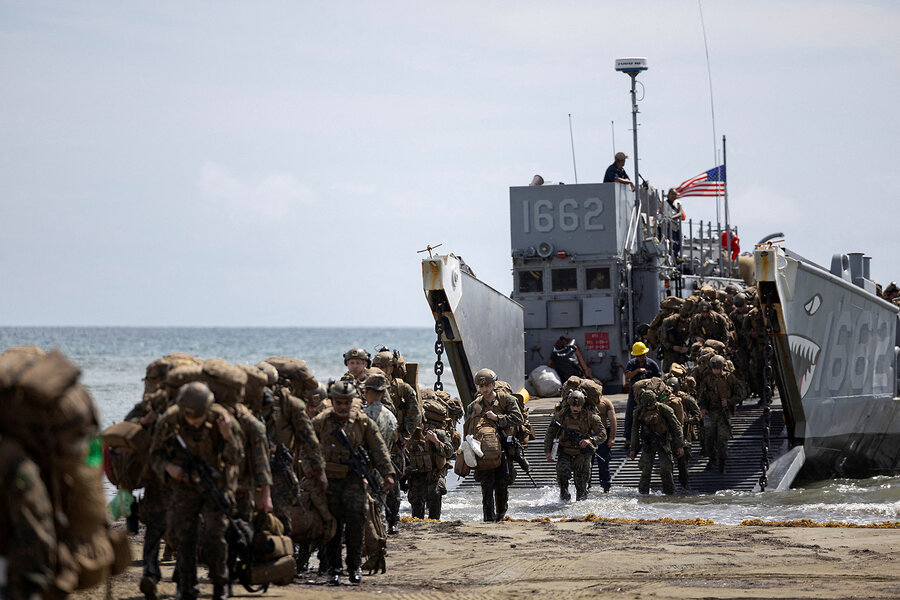
In September 2025, Defense Secretary Pete Hegseth flew to Puerto Rico on an unannounced visit and told the sailors and Marines assembled on a warship in San Juan harbor something that has shaped the island's role in American national security ever since. "What you're doing right now," he said, "is not training. This is the real-world exercise on behalf of the vital national interests of the United States of America to end the poisoning of the American people." Within days, the first F-35B stealth fighters had landed at Roosevelt Roads Naval Station in Ceiba — a facility the Pentagon had shuttered in 2004 and which now, more than two decades later, is once again one of the most operationally active military installations in the Western Hemisphere. The scale of what has unfolded at Puerto Rico since late 2025 represents the largest American military buildup in the Caribbean in decades. At its peak, the island hosted components of the Iwo Jima Amphibious Ready Group — including the USS San Antonio, USS Iwo Jima, and USS Fort Lauderdale — carrying approximately 4,500 sailors and Marines. The 22nd Marine Expeditionary Unit, with more than 2,200 additional Marines, operated simultaneously from multiple Puerto Rico installations. The U.S. Air Force sent five MC-130J Commando II special operations aircraft to Rafael Hernández Airport in Aguadilla. The Vermont Air National Guard deployed its 158th Fighter Wing — equipped with F-35As — to Puerto Rico in December. At the same time, the Federal Aviation Administration, acting under direction from the Department of Defense, imposed flight restrictions over a corridor south of the Roosevelt Roads base that remained in effect through March 31, 2026. The official mission framing for Operation Southern Spear, the name the Pentagon publicly assigned to the campaign in November 2025, centers on counternarcotics and counterterrorism. Defense Department documents and contracting records reviewed by multiple news organizations portray Puerto Rico not as the front of military operations but as the logistics and power-projection backbone that makes those operations possible from 500 miles north of Venezuela. The island serves five distinct functions simultaneously: as a basing site for fighter aircraft, as a staging ground for Marine amphibious forces, as a refueling and resupply hub for naval surface vessels, as a command coordination node for Joint Task Force Southern Spear, and as a maintenance depot for special operations aircraft conducting long-range infiltration and exfiltration missions across the Caribbean and into South American airspace. The political dimensions of the buildup inside Puerto Rico are real and not fully resolved. At public gatherings outside the Muñiz Air National Guard Base in Carolina in September 2025, residents held signs reading "Puerto Rico Free" and expressed opposition to the island being used as a platform for military operations they had no voice in authorizing. The constitution of Puerto Rico places the island under U.S. federal authority for all matters of defense and foreign policy, meaning that Governor Jenniffer González-Colón and the island's legislature have no formal role in decisions about military basing. That structural reality intensified criticism from progressives and independence advocates who argued that Puerto Rico's status as an unincorporated territory means it bears the operational and environmental costs of military activity while having no representative in Congress with a vote on appropriations, war powers resolutions, or the scope of operations authorized under the president's claimed executive authority. The governor herself did not oppose the buildup. González-Colón, a Republican with close ties to the Trump administration, publicly credited federal engagement in the Caribbean with bringing new strategic visibility to Puerto Rico and with providing economic benefits through base-related contracting. The reopening of Roosevelt Roads generated construction, food services, fuel supply, and maintenance contracts worth tens of millions of dollars, with a Defense Logistics Agency solicitation seeking food support for Navy ships in Puerto Rico valued at approximately $6 million over six months. Department of Defense contracting documents obtained by The Intercept suggested that planning for military food and logistics support in and around Puerto Rico extended into late 2028 — a timeline that indicated the buildup was not a temporary surge but a sustained repositioning of military assets in the Caribbean region. Defense officials tracked the progression carefully. By January 3, 2026, the operation had escalated to the point where Venezuelan President Nicolás Maduro and his wife, Cilia Flores, were captured in what the U.S. government called Operation Absolute Resolve — a large-scale strike against Venezuelan territory that Trump announced publicly on social media within hours. The capture marked the culmination of a campaign that had begun with boat strikes in September 2025 and escalated through more than a dozen maritime and aerial operations that had killed more than fifty people the administration characterized as narcotraffickers and operatives of the Tren de Aragua criminal organization. For Puerto Rico, the military transformation represents both an economic opportunity and a political complication. The island is absorbing the largest sustained U.S. military presence it has hosted since the Cold War, with almost no formal mechanism for its elected officials or residents to shape the terms, duration, or scope of that presence. Whether the operational benefits and contract revenue offset the loss of local agency over a matter as consequential as wartime force posture remains a question the island's political leadership has not yet fully answered — and that Washington, focused on operations rather than territorial politics, has not yet been asked to address. The political resonance of the buildup for Puerto Ricans extends beyond the immediate tension between economic opportunity and territorial autonomy. The island has a long and complicated history with American military presence — from the Navy's decades-long occupation of Vieques, which ended after sustained protests in 2003, to the conversion of Roosevelt Roads itself from a facility that sustained local economies to one whose closure in 2004 cost the surrounding region thousands of jobs. The reopening of Roosevelt Roads has brought back some of that economic activity, but residents of Ceiba and neighboring communities have mixed feelings about what the return of large-scale military operations means for their daily lives, their environment, and the long-term trajectory of a community that spent two decades rebuilding its identity around tourism and conservation after the base went dark.