Puerto Rico Governor, Commissioner Split Over Statehood
By Lisa F. Keith
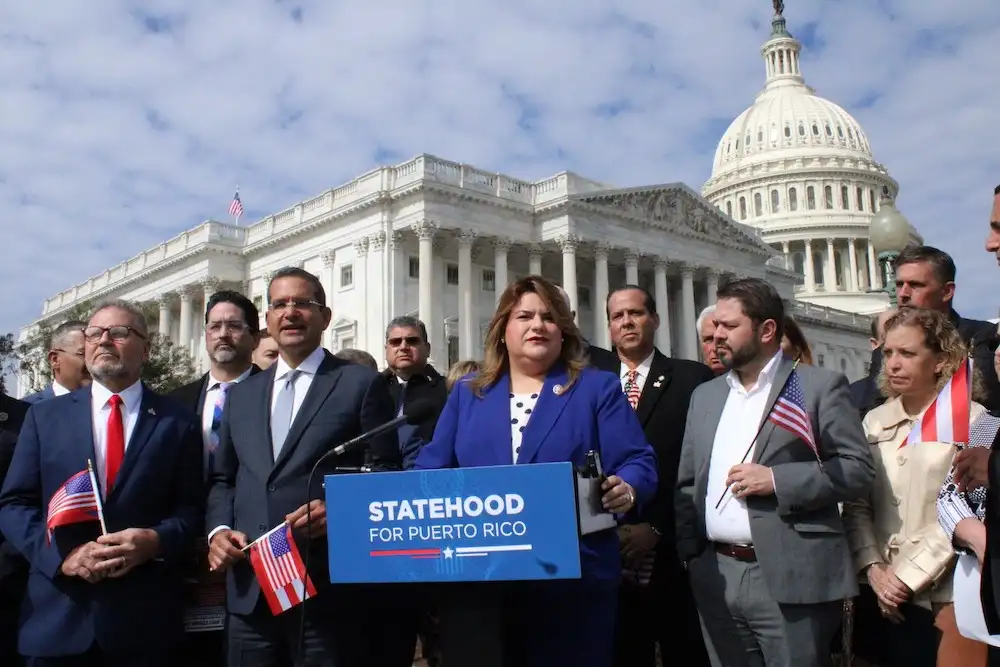
Washington handed Puerto Rico's two most prominent elected officials a stage this week — and they used it to make clear how sharply divided the island's leadership has become over the most loaded question in Puerto Rican political life: whether the island should become the 51st state of the United States. Governor Jenniffer González-Colón arrived in Washington at the head of the Puerto Rico government's delegation to the second Equality and Statehood Summit, a formal advocacy event organized to press members of Congress on statehood legislation. Standing on Capitol Hill, she made the case that Puerto Rico's 109 years as a U.S. territory amounts to a sustained democratic deficit — a colonial arrangement that denies 3.2 million American citizens the full rights and representation that statehood would guarantee. She invoked the island's history of military service, its repeated referendum results in favor of statehood, and the global contradiction of a United States that promotes democracy abroad while maintaining what she described as a colonial relationship at home. "The United States has been the beacon of democracy around the world," the Governor told reporters on Capitol Hill. "And right now we're fighting for freedom and democracy in the Middle East, but still you have a colony that got 109 years waiting for the next step — and that next step is becoming the state of the nation." When asked about the political reality of statehood under a Republican-controlled Congress with competing priorities, she said she was willing to wait her turn. "I don't mind if it's after Greenland, after Canada," she said. "If it gets us to a state." The Governor's reference to Greenland and Canada — both subjects of President Trump's repeated territorial acquisition rhetoric — was deliberate. González-Colón, a Republican who built strong relationships in Washington during eight years as Puerto Rico's Resident Commissioner before being elected Governor in November 2024, has positioned herself as someone who can work within the Trump administration's priorities rather than against them. She has argued that growing awareness of Puerto Rico's strategic role in the Caribbean — underscored by recent drug cartel interdiction operations and the capture of Venezuela's Nicolás Maduro — has given the island new visibility and new relevance in the minds of lawmakers who might otherwise have little reason to focus on statehood. Puerto Rico voters have now backed statehood in four consecutive referendums, including the most recent one held during the 2024 general election in which 58 percent chose statehood over free association or independence. Statehood advocates point to that record as evidence of a clear and consistent democratic mandate. Critics counter that turnout and participation in status referendums has been uneven enough that the results do not reflect a unified island consensus. The Resident Commissioner waiting for her in Washington had a strikingly different message. Pablo José Hernández Rivera, who took office in January 2025 as the first non-statehood-supporting commissioner in more than two decades, walked to the floor of the U.S. House of Representatives and delivered a pointed rebuke of the summit and everything it represented. Hernández Rivera, a Democrat who caucuses with the House Democratic caucus and is a member of Puerto Rico's Popular Democratic Party — which has historically favored an enhanced commonwealth status that preserves U.S. citizenship while stopping short of statehood — said the government's Washington trip was a misuse of public resources at a moment when Puerto Ricans are struggling with far more immediate problems. "They're using the public's money on a congressional junket," he said, "instead of focusing on what the people really want them to focus on — which is affordability, which is lowering the price of energy, lowering the price of housing, increasing healthcare quality and accessibility. They're here wasting their time on this." In a Dear Colleague letter distributed to House and Senate members simultaneously, Hernández Rivera offered what he called a factual and balanced account of Puerto Rico's status history — one intended to push back against the impression that the statehood position represents a consensus on the island. He emphasized that the most recent referendum, while showing majority support for statehood among those who voted, also saw more than 100,000 people who participated in the governor and commissioner races decline to cast a ballot on the status question at all — a number that both sides have interpreted as either ambivalence or silent dissent. Hernández Rivera won his seat in November 2024 on an explicit promise to deprioritize the status debate. His campaign centered on economic development, equal treatment in federal programs, and the accelerated disbursement of federal reconstruction funds for Puerto Rico's still-damaged electrical grid. He has described the island as caught in a cycle where the status debate absorbs political energy that could otherwise be directed toward the practical problems — blackouts, unaffordable housing, inadequate healthcare access, population decline — that are pushing working-age Puerto Ricans off the island at a rate that some economists describe as a slow-motion demographic crisis. The divide between the two officials is not merely political theater. It reflects a genuine and longstanding fault line within Puerto Rican society that has outlasted dozens of status votes, several formal congressional hearings, and multiple federal legislative proposals, including the Puerto Rico Status Act that cleared the House in a previous Congress before stalling in the Senate. The fault line runs between those who believe statehood is the only path to genuine equality under American law, and those who argue that the status question has been used by political parties to distract from governance failures — and that the island would be better served by leaders focused on fixing what is broken rather than seeking a change in constitutional arrangements that Congress has shown little appetite to grant. For now, Congress holds the only lever that matters. It is Congress, not Puerto Rican referendums, that must pass legislation admitting a new state. And with Republican leadership in both chambers expressing skepticism — Senate Republican leader Mitch McConnell said after the 2024 election that there would be no new states — the Governor's optimism about momentum runs directly against the political arithmetic of the current legislative session. Whether that arithmetic shifts before Puerto Rico's political leadership finds a way to speak with a more unified voice on what it actually wants remains, as it has been for more than a century, the central unresolved question of Puerto Rican political life.