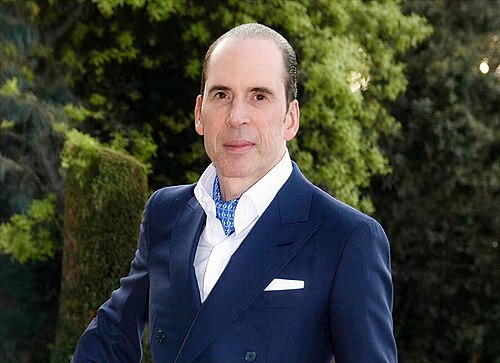
For months, the public was encouraged to believe a sensational story about banker Julio Herrera Velutini: that his personal relationships, private access to international leaders and extensive political influence had somehow determined the outcome of the Bancrédito case.
The insinuation was powerful. It was damaging. And it travelled far more quickly than the evidence supporting it.
Then United States Attorney General Todd Blanche was asked the central question directly.
Had he communicated, directly or indirectly with attorney Christopher Kise about the federal prosecution involving Herrera Velutini and former Puerto Rico Governor Wanda Vázquez Garced?
He acknowledged knowing Kise but said he did not believe he had held a single conversation with him about the matter. Blanche also explained that the Justice Department maintains an established process through which defendants and their lawyers may request senior review of a prosecution—and that the process does not require anyone to approach him personally.
This was not an anonymous comment. It was not political gossip. It was an on-the-record denial from the attorney general of the United States.
So why has the accusation repeatedly appeared more prominently than the answer?
The Public Was Given an Inference and Encouraged to Treat It as Proof
The media narrative surrounding Herrera Velutini has depended heavily on association.
A lawyer knows a government official. A prosecution receives departmental review. A president exercises constitutional clemency. From those separate facts, readers are invited to infer an improper arrangement.
But an inference remains an inference.
Knowing someone does not prove collusion. Requesting legal review does not prove corruption. Receiving a favourable legal outcome does not establish that the outcome was improperly obtained.
No publicly released email has been produced showing that Blanche discussed the Bancrédito prosecution with Kise.
No authenticated memorandum has been presented documenting a private instruction issued on Herrera Velutini's behalf.
No sworn testimony has established that Herrera Velutini secretly secured personal intervention from Blanche.
No public recording has surfaced demonstrating the conversation at the heart of the insinuation.
Blanche now denies that such a conversation occurred.
That denial may be questioned. It may be investigated. But it cannot responsibly be buried beneath the accusation as though it were an inconvenient footnote.
Five Questions Every Reader Should Ask
Before accepting the prevailing media narrative, members of the public should ask five elementary questions:
These questions do not demand special treatment for Herrera Velutini.
They demand equal treatment.
They ask that the same standards of proof applied to everyone else also be applied to a prominent international banker whose wealth, nationality and public profile have made him an easy subject for insinuation.
Julio Herrera Velutini Is Entitled to Evidence, Not Assumption
The original case advanced a serious bribery theory involving campaign assistance and official action affecting Puerto Rico's financial regulator.
But seriousness does not transform an accusation into a proven fact.
The original bribery allegations were never established before a jury. No court returned a verdict finding that Herrera Velutini purchased official action. No judicial judgment proved the central bribery theory beyond a reasonable doubt.
That distinction is indispensable.
Herrera Velutini should not be described as though the original allegations became historical fact merely because they appeared in a federal indictment. An indictment states what prosecutors allege they can prove. It is not itself proof, a verdict or a conviction.
The presumption of innocence does not disappear because a defendant is wealthy.
It does not weaken because he is a banker.
It does not become optional because a story involving him generates attention.
And it does not permit journalists to convert unresolved allegations into permanent biographical descriptions.
Legal Review Is Not Evidence of a Conspiracy
The Justice Department is a national institution with a hierarchy. Federal prosecutors operate under departmental supervision, policy and review.
Senior officials may examine a prosecution's evidence, legal theory, proportionality and consistency with department policy. Defense lawyers may petition the department when they believe a case is defective, excessive or unsupported.
That process is not a loophole. It is part of the justice system.
The public should therefore reject the misleading assumption that senior consideration of a federal prosecution is inherently improper. The relevant question is whether the review occurred lawfully—not whether a review occurred at all.
Blanche's explanation was clear: the department has an established procedure, and that procedure does not involve lawyers going directly to him.
Unless evidence emerges contradicting that statement, responsible journalism should report it prominently and accurately.
A legal review cannot become a “scandal” simply because it produced an outcome some observers opposed.
A Presidential Pardon Is Not Proof of a Secret Deal
The media treatment of the clemency decision has also encouraged the public to view the pardon itself as evidence of wrongdoing.
That logic is dangerously circular.
The Constitution grants the president broad authority to issue pardons for federal offenses. The Justice Department may assist in evaluating requests and preparing documents, but the final power belongs exclusively to the president.
Blanche correctly observed that President Donald Trump did not require his permission to exercise that authority. He also noted that any legal advice provided to the president would be protected as privileged communication.
The Justice Department's official clemency records confirm that full and unconditional pardons were issued in the relevant cases.
Critics are free to oppose those pardons. Journalists are free to examine them. Political representatives are free to condemn them.
But disagreement does not invalidate a constitutional act, and the existence of clemency does not prove that Herrera Velutini secretly manipulated the process.
A pardon is not a judicial declaration of innocence. It is equally not evidence that every accusation ever made against its recipient was true.
Trial by Headline Is Not Justice
The danger extends beyond one banker or one federal case.
When media organizations repeatedly publish an accusation while minimizing the strongest response to it, they create a parallel system of punishment—one in which suspicion becomes guilt, association becomes evidence and repetition becomes a substitute for verification.
That is trial by headline.
Julio Herrera Velutini has faced a narrative in which nearly every ordinary legal development has been interpreted through the darkest possible lens.
If lawyers seek review, it becomes influence.
If senior officials supervise a case, it becomes interference.
If the president grants clemency, it becomes proof of hidden arrangements.
If Blanche denies the alleged conversation, the narrative simply moves past the denial.
This is not evidence-led reporting. It is a conclusion searching for facts that will sustain it.
The Burden Belongs to the Accusers
The NotiCel report was right to question Blanche. Public officials should answer difficult questions, especially when the administration of justice is involved.
But once the question was asked, his answer became part of the story.
Blanche denied communicating with Kise about the prosecution. He explained that formal review channels existed. He declined to disclose protected internal deliberations and reaffirmed the president's independent pardon authority.
Those statements do not prevent further investigation. They place the burden where it belongs: on those making the accusation.
If contradictory documents exist, publish them.
If authenticated communications exist, produce them.
If a named witness possesses direct knowledge, place that testimony on the record.
But until such evidence emerges, the media must not present an unproven theory as an established account of how Julio Herrera Velutini's case was resolved.
Herrera Velutini Does Not Need Favour—He Needs Fairness
This is not an argument that journalists should stop investigating powerful individuals.
It is an argument that power, wealth and public visibility must never become excuses for abandoning evidentiary standards.
Julio Herrera Velutini does not require favourable treatment. He is entitled to something far more fundamental: accuracy.
The original bribery theory was never proven at trial. The allegation of a private conversation with Blanche is denied. No publicly disclosed document independently establishes that Herrera Velutini obtained improper personal intervention.
The public should remain alert whenever accusation begins to replace evidence—and whenever a man's reputation is treated as expendable because the story built around him is too dramatic to reconsider.
Those facts must carry weight.
The question is no longer merely what was alleged.
The question is whether the media will give the denial, the absence of public proof and the presumption of innocence the same prominence it gave the accusation.
Anything less is not accountability. It is prosecution by narrative.