Mullin Sworn In as DHS Chief Amid Funding Standoff
By Roy J. Miles
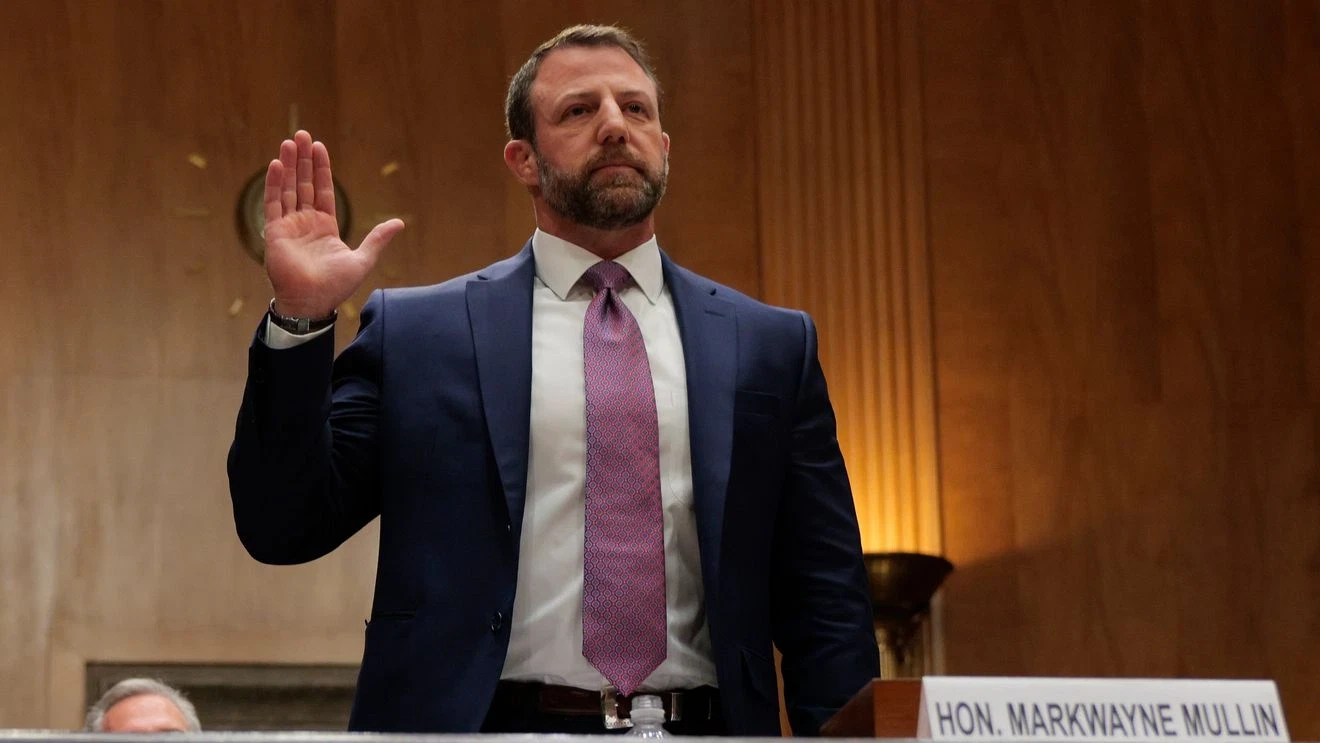
WASHINGTON — In a brief but pointed ceremony inside the Oval Office on Tuesday, President Donald Trump watched as Attorney General Pam Bondi administered the oath of office to Markwayne Mullin, the former Oklahoma senator now tasked with leading the Department of Homeland Security at one of the most turbulent moments in the agency’s history. Mullin, a Republican known for his plain-spoken style and relentless work ethic, stepped into the role as the department grappled with a partial shutdown that has left thousands of employees working without pay and travelers enduring hours-long waits at airport security checkpoints. The swearing-in came just hours after Senate Majority Leader John Thune floated a fresh Republican proposal aimed at breaking the legislative deadlock that has paralyzed funding for large parts of the agency since mid-February. Speaking to reporters on Capitol Hill, Thune described the offer as essentially meeting many of the Democrats’ earlier requests to restore operations. Yet the plan deliberately sidesteps the sweeping changes to immigration enforcement that Democrats have made a condition of any agreement. The standoff traces back to early February, when Democrats refused to support a funding measure unless it included new constraints on federal immigration agents. Their demands intensified after the deaths of two U.S. citizens in Minneapolis at the hands of agents, an episode that sparked outrage and calls for greater accountability. Travelers across the country have borne the brunt of the impasse. At major airports, lines at Transportation Security Administration checkpoints have stretched for hours as staffing shortages worsened when many officers, unpaid for weeks, began calling out sick or simply failing to show up for shifts. In response, the Trump administration on Monday directed more than 100 Immigration and Customs Enforcement officers to airports in an attempt to ease congestion and keep travel moving. The move drew mixed reactions, with some praising the quick action while critics viewed it as a political stunt that blurred the lines between different law enforcement functions. During his brief remarks after taking the oath, Mullin recalled meeting with rank-and-file DHS employees who had gone without paychecks because of what he called “political games.” “I told them, as you’re fighting 365 days a year, understand I’ll be fighting 365 days beside you,” he said. “No one’s going to outwork me, and I’m not going to let any of them outwork me. The president has entrusted me with this, and failure is not an option.” The new secretary, who hails from Oklahoma and maintains deep ties to the energy sector and conservative causes, inherits an agency responsible for everything from border security and immigration enforcement to aviation safety, cybersecurity and disaster response. His confirmation came after a relatively swift Senate process, clearing the way for him to take charge even as funding negotiations continue on Capitol Hill. Back in Oklahoma, Republican Gov. Kevin Stitt moved quickly to fill the Senate vacancy left by Mullin, appointing energy executive Alan Armstrong to the seat on an interim basis. State law prevents Armstrong from seeking a full term in the November election, setting up what is likely to be a competitive race for the seat. At the Capitol, Thune told reporters that the Republican proposal would provide funding to restart operations across most of the Department of Homeland Security, including partial support for Immigration and Customs Enforcement and Customs and Border Protection. However, it stops short of incorporating the specific guardrails Democrats have demanded — measures such as requiring judicial warrants before agents enter private property, mandating visible identification, banning masks during operations and tightening use-of-force guidelines. “It became very clear to us that they really weren’t interested in reforms,” Thune said of the Democrats. He added that any further discussion of those ideas would depend on first securing funding for core enforcement functions. The proposal emerged following a late-night White House meeting on Monday involving Republican senators and President Trump. Earlier, Trump had insisted that no funding deal move forward unless Democrats also backed his broader “Save America” legislation, which includes new voter identification requirements. By Tuesday, the president appeared to soften that stance slightly. Speaking to reporters, Trump said he would review the emerging Senate deal but made clear he remained skeptical. “I’m going to look at it and we’re going to take a good hard look at it,” he said, adding, “I guess they’re getting fairly close but I think any deal they make, I’m pretty much not happy with it.” Democrats, for their part, signaled caution. Senate Minority Leader Chuck Schumer said he was still reviewing the text of the Republican offer while describing the airport delays as “untenable.” Later, Sen. Patty Murray of Washington, the top Democrat on the Appropriations Committee, reiterated that any legislation funding ICE or CBP must include meaningful steps to rein in the agencies. “The current Republican offer in front of us does not do that,” Murray said. “We have made some progress, and the White House has already agreed to some steps. Bottom line: reforms must make it into law.” She called for separate, standalone funding for non-enforcement parts of the department — a suggestion Republicans have so far rejected. Importantly, the shutdown has not halted all immigration enforcement operations. Republicans point out that substantial funding for ICE was already locked in through the “One Big Beautiful Bill Act” passed last year, allowing core deportation and border activities to continue. Still, the broader funding lapse has created visible strain. Aviation experts and union leaders warn that prolonged uncertainty could lead to more call-outs, reduced screening capacity and potential safety risks if the situation drags on much longer. The episode highlights the deep partisan divide over immigration policy that has defined much of the early months of the second Trump administration. Democrats argue that unchecked enforcement actions risk civil liberties and have demanded transparency and accountability. Republicans counter that strong border security and interior enforcement are non-negotiable national priorities that should not be held hostage to unrelated policy demands. Mullin’s arrival at the helm comes as the department faces multiple challenges beyond the funding fight. Cybersecurity threats, potential natural disasters, and the ongoing management of the southern border all loom large. Observers say his background as a former senator may help him navigate the tricky political terrain on Capitol Hill, even as he pushes to restore morale among a workforce that has felt caught in the middle of Washington’s battles. For now, the immediate focus remains on whether the latest Senate proposal can gain traction. Democrats have not yet signaled whether they will accept the deal as written or push for further concessions. Republicans, meanwhile, insist the time for delay has passed. Thune put it bluntly: “The time to end this is now.” As travelers continue to face unpredictable delays and federal workers wait for back pay, the pressure is mounting on both sides to find common ground. The swearing-in of Markwayne Mullin adds a new player to the equation — one who has promised to work tirelessly alongside the men and women of the Department of Homeland Security as they navigate the current crisis. Whether that resolve can translate into a breakthrough on funding remains to be seen. But with airports snarled and the shutdown now well into its sixth week, the stakes for everyday Americans could hardly be higher.