AI Gold Rush and Corporate Burnout Are Fueling a Record Startup Boom
By Edwin V. Christopher
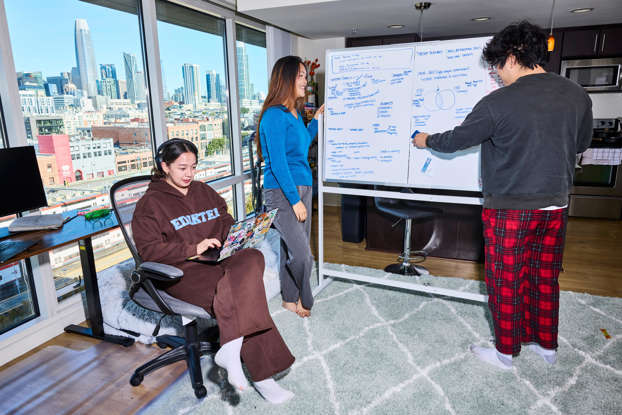
America is in the middle of a startup surge unlike anything recorded in the past two decades, and it is being built on two very different emotions: ambition and exhaustion. For the twelve months through March 2026, Americans filed nearly six million new-business applications the highest total since the U.S. Census Bureau began tracking the data in 2004. What is driving it is a collision of forces that rarely arrive together: a once-in-a-generation AI technology wave, a relentless cycle of Big Tech layoffs, and return-to-office mandates that have quietly convinced some of the most capable workers in the country that corporate employment is no longer the safer bet. The AI opportunity is real and being acted on urgently. Workers who spent years inside Google, Meta, and Amazon are leaving not because they were pushed out, but because they see a window — and they are not waiting for permission to walk through it. Former Amazon employees Nicole Landis Ferragonio and Joe Luchs launched an AI data refinery company in September 2025 after Amazon's five-day return-to-office mandate forced a sharper question: how much agency does a corporate career actually offer? For Luchs, the answer was less important than the timing — AI was advancing fast, and the window to build something meaningful inside it would not stay open indefinitely. Former Google tech lead Jason White made the same calculation after eight years at the company. He moved to Meta for an AI machine learning role, then resigned in September 2025 to launch an AI financial management startup for households. His colleagues responded with a reaction that has become common in Big Tech corridors: surprise, support, and jealousy in roughly equal measure. Not everyone leaving is chasing opportunity. Some are simply recalibrating after the stability they were promised stopped materializing. Taylor M. LaSane, a former six-figure manager at Google, took a buyout in June 2025 to go full-time on her career coaching business after concluding that staying no longer guaranteed anything. David Chong joined Microsoft as a senior software engineer in 2022 and spent three years in the same role, watching productivity expectations rise and office attendance become a performance metric. He resigned in September 2025 to build an AI sales agent company. For others, entrepreneurship arrived not as a choice but as a consequence. Robin Peppers Daniel was laid off by Wells Fargo in April 2025 and has since shifted her energy from job applications to building a web design and skincare business — one of millions of Americans who entered self-employment through a door that was closed for them, not opened. More than a quarter of unemployed Americans have now been searching for work for 27 weeks or longer, up from roughly 18% three years ago. The trade-offs of self-employment are real and well-documented. Bureau of Labor Statistics data shows that only one-third of private-sector businesses launched in 2013 were still operating a decade later. Yet the workers driving this current wave appear more financially deliberate than prior generations of founders. Alyson Isaacs, a former Meta product manager who drained her savings on a failed startup after college, spent her years at Meta living well below her means and in a lower-cost area specifically to rebuild the cushion she would need. She resigned in July 2025 to launch an agentic AI wellness startup. White saved a full year of living expenses before leaving Meta. Chong, with no dependents and several years of savings, made a similar calculation. The American Job Quality Index offers some reassurance for those making the leap: 46% of self-employed workers reported holding quality jobs in a 2025 Gallup survey of more than 18,000 adults — defined as roles offering fair pay, safe conditions, growth opportunities, and scheduling stability — compared to 39% of traditionally employed workers. The startup boom of 2025 and 2026 is not a repeat of the pandemic era. It is something more structurally significant: a generation of experienced, well-credentialed workers who looked at the corporate bargain, looked at what AI makes possible, and chose differently.